



Textbook - Illustrated Introduction to Robotics for Beginners | Hardcopy + Digital Copy | All Ages
Textbook - Illustrated Introduction to Robotics for Beginners | Hardcopy + Digital Copy | All Ages
Available in stock
A beginner-friendly, illustrated robotics textbook that helps students build a strong foundation in robotics, engineering, programming, automation, and AI. Designed for learners ages 10–15.
Product Features
- 10 chapters covering robotics fundamentals through AI
- Colorful illustrations, real-world examples, and student dialogs
- Chapter assessments with answer keys
- Making & Doing hands-on activities and engineering challenges
- Covers robot components, motion, forces, kinematics, sensors, programming, and AI
- Ideal for middle school STEM, robotics, engineering, introductory CTE, clubs, and homeschool
- Available in physical and digital editions
Couldn't load pickup availability
- Order will be shipped out from US warehouse in 1-3 business days once being processed.
ABOUT THE TextBOOK
A strong first step into robotics.
The book helps young learners build a clear, connected understanding of robotics. Designed for ages 10–15, from upper elementary through middle school and early high school, it introduces core robotics concepts in a visual, accessible, and engaging way.
Colorful illustrations, real-world examples, student dialogs, assessments, and hands-on activities help make technical ideas easier to understand and more engaging to learn.
Students begin with the fundamentals—what robots are, how they are built, and how they move—then gradually explore coordinate systems, forces, kinematics, sensors, programming, automation, and artificial intelligence.
Along the way, students develop problem-solving, systems thinking, creativity, communication, teamwork, safety awareness, and responsible design.
By the end of the book, students will have a strong foundation for continued learning in robotics, engineering, programming, automation, and AI.
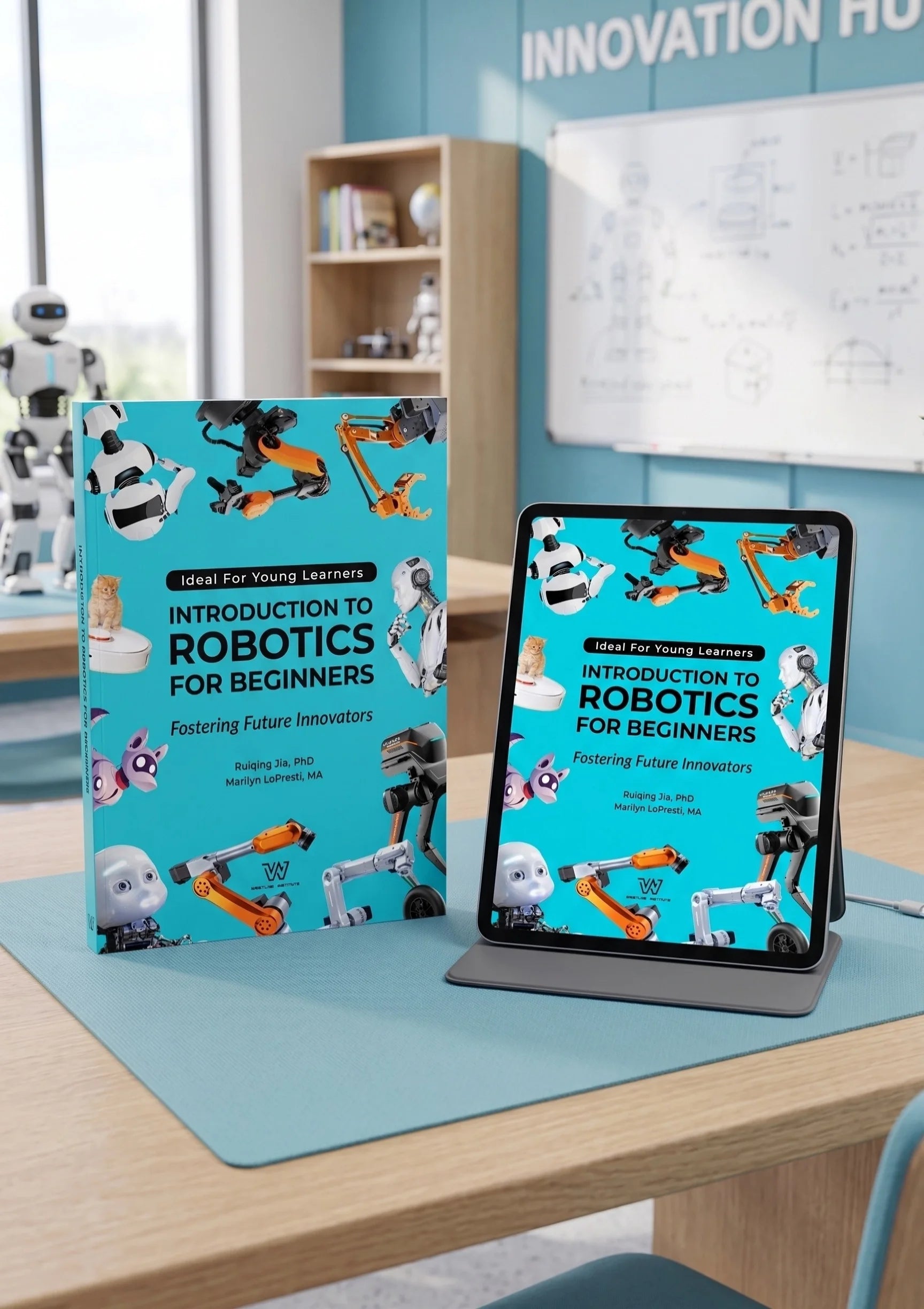
The book is available in both physical and digital formats.

WHAT MAKES THIS ROBOTICS BOOK DIFFERENT
It teaches the ideas behind robotics — not just how to run a robot.
Introduction to Robotics for Beginners is built for young learners just starting out. Instead of memorizing buttons, kids explore the core concepts of robotics through hands-on projects and friendly illustrations — ideas that stay useful no matter which robot, kit, or platform comes next.
Ideal for Young Learners
Approachable language, colorful robot illustrations, and step-by-step explanations make robotics exciting and easy to grasp for beginners and curious kids.
Concepts That Transfer
Hands-on robotics fundamentals — sensors, motors, logic, and problem solving — that stay useful across any robot, kit, or platform a young innovator meets next.
Print & Digital Editions
Read it your way — a beautifully printed paperback for the shelf, or an instant high resolution digital edition to explore on any tablet at home or in the classroom.
THE LEARNING JOURNEY
Ten chapters. One connected story.
The book moves from visible, intuitive ideas toward more abstract engineering concepts. Each chapter prepares students for the next.
Part 1
What is a robot?
Chapters 1–3: Foundations of Robotics
Students learn what robotics is, the main features and types of robots, how robots are built — structures, Degrees of Freedom, transmission and control systems — and how position and orientation work using the Cartesian coordinate system.
Part 2
Where is it, and how does it move?
Chapters 4–6: Frames, orientation & Real-World Robots
Students explore the concepts of reference frames and robot orientation, point-to-point movement and path planning (including Blockly), and see how robots are applied across industries through real special-purpose robots.
Part 3
Why does it move that way?
Chapters 7–8: Forces, Motion & Kinematics
Students study Newton's three laws, torque and rotation, how forces move robot end-effectors, and the comcepts of kinematics of elementary and industrial robot arms.
Part 4
How does it sense and decide?
Chapters 9–10: Sensors & AI in Robotics
Students learn how robots sense the world — vision, distance, force and acceleration sensors — like the human senses, then discover the ideas of how AI powers robotics across healthcare, finance, transportation, logistics, agriculture, manufacturing and energy.
consistent learning flow in every chapter
A textbook students can actually enter.
Every chapter blends visual explanations, short discussions, summaries, assessments, and hands-on activities into a clear, consistent rhythm for teaching and learning.
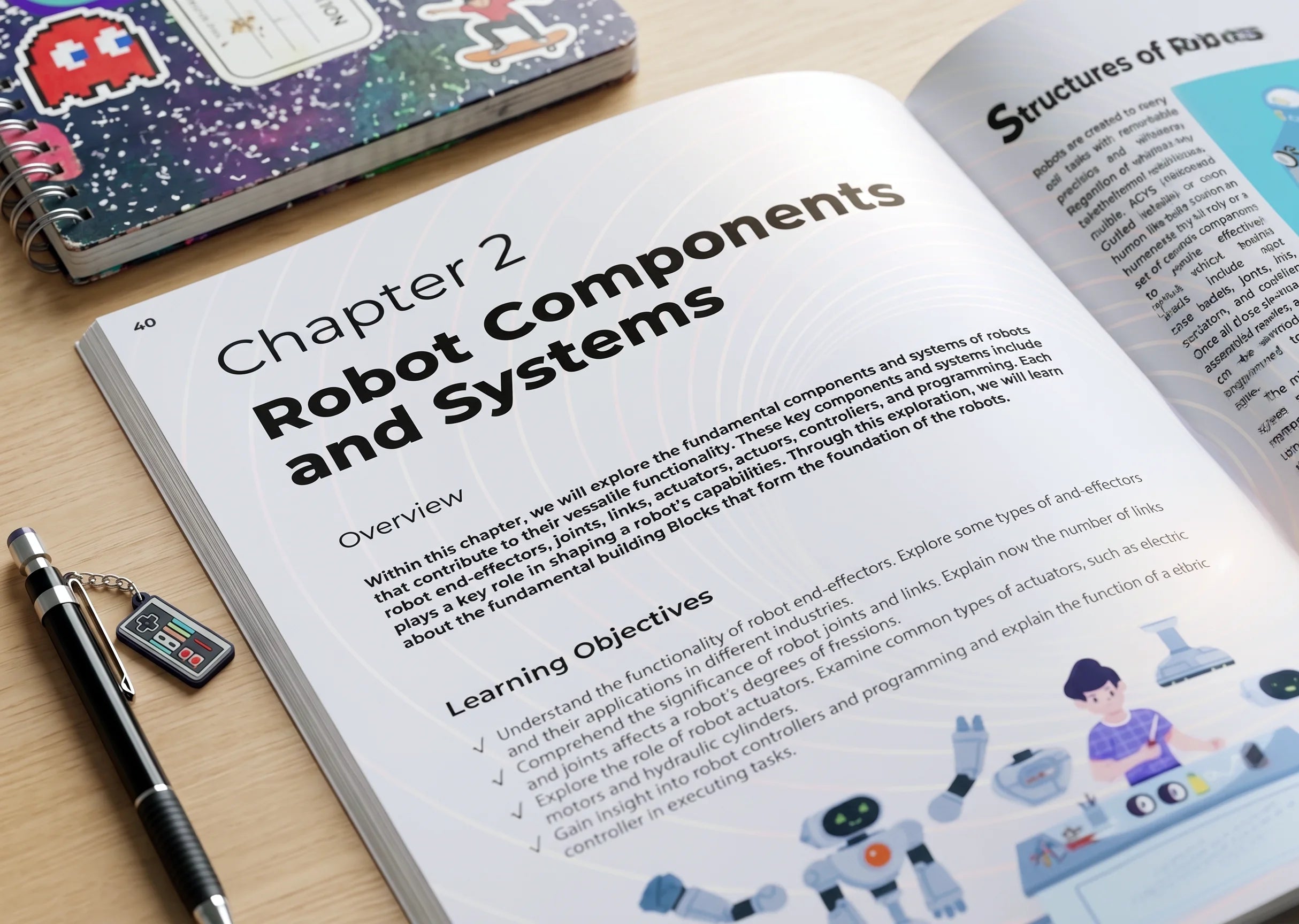
Every chapter begins with Overview and Learning Objectives.
Chapter Beginning — Set the Purpose
Every chapter begins with purpose.
Each chapter opens by giving students the overview and learning objectives first, so they understand where they're headed before diving into the details.
Clear chapter overview
Student-facing learning objectives
Visualized concept and maps
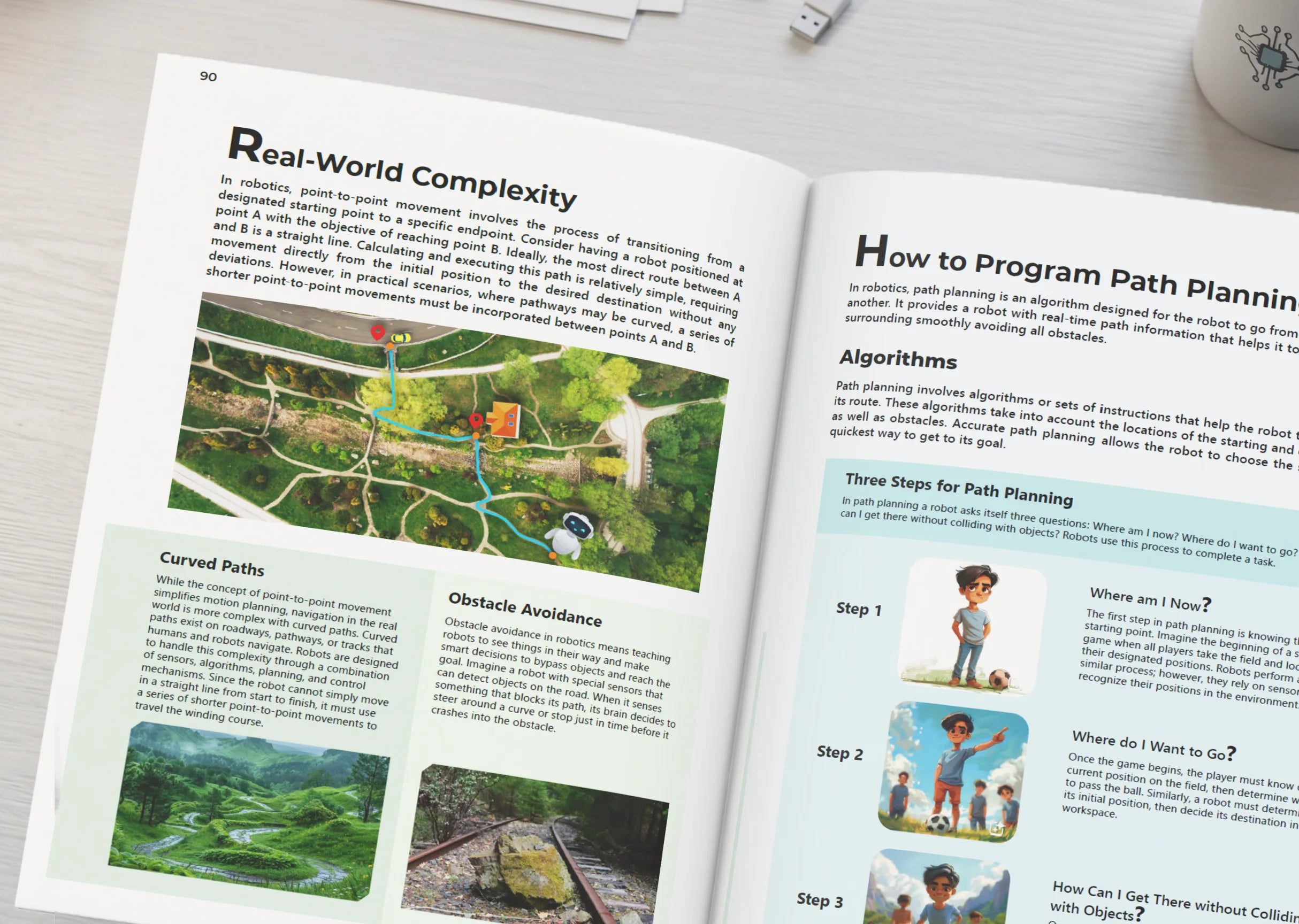
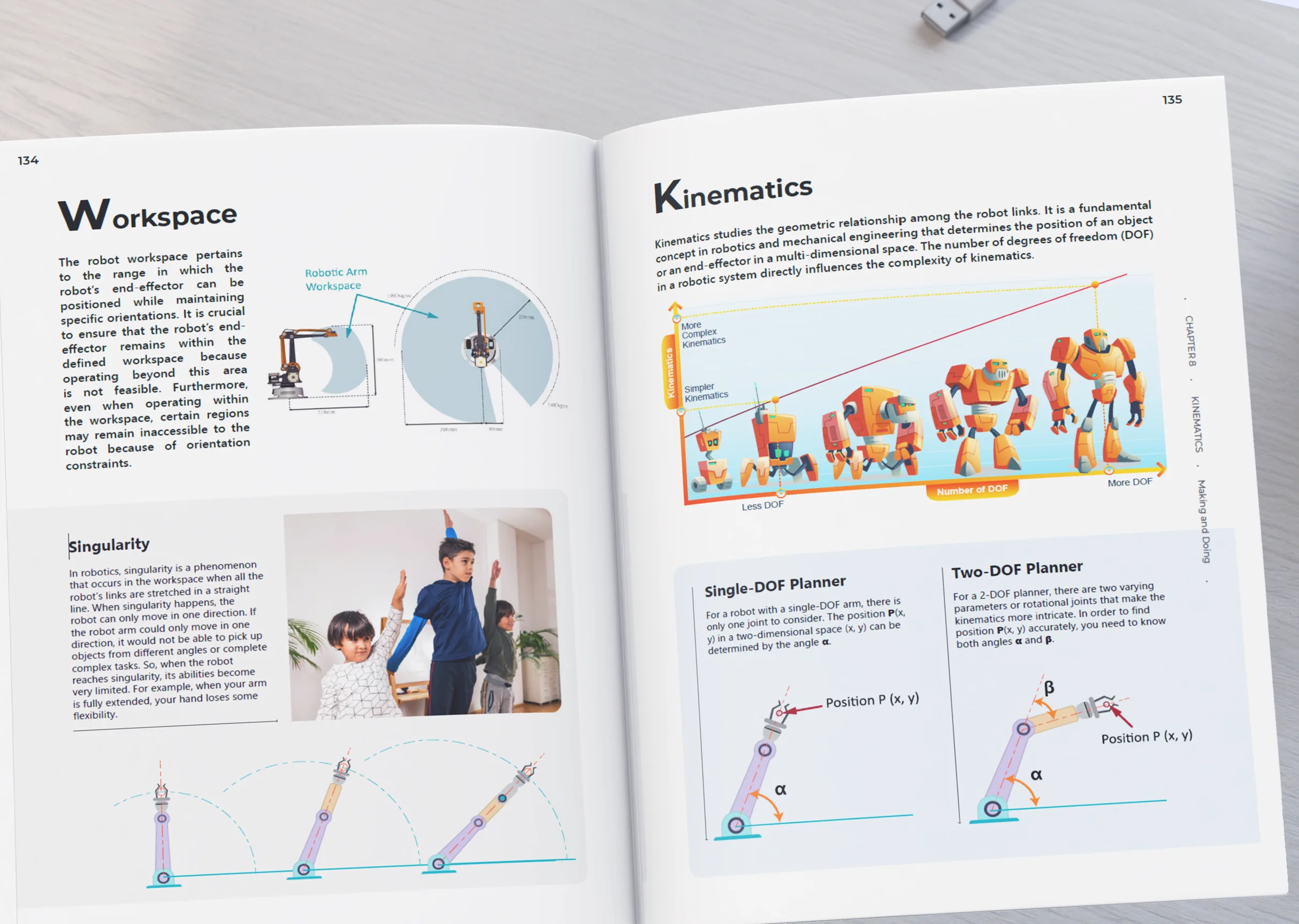
Chapter Body That Makes Concepts Visual
Chapter Body — Make Concepts Visual
Complex systems become visible.
Illustrations break a robot into the pieces students need to recognize. The text explains what each part contributes to the whole system.
Technical vocabulary introduced in context
Mechanical + electrical + control concepts
System-level thinking
Diagrams students can refer back to
Connections to real robot structures
Chapter Dialogs — Talk It Through
Dialogs turn technical ideas into questions students might actually ask.
Jack, Ella, and Mr. Henry give the book a classroom voice. Their conversations help students revisit key ideas in ordinary language before moving on.
Supports classroom discussion
Encourages students to explain concepts
Makes technical vocabulary more approachable
Adds continuity across the book
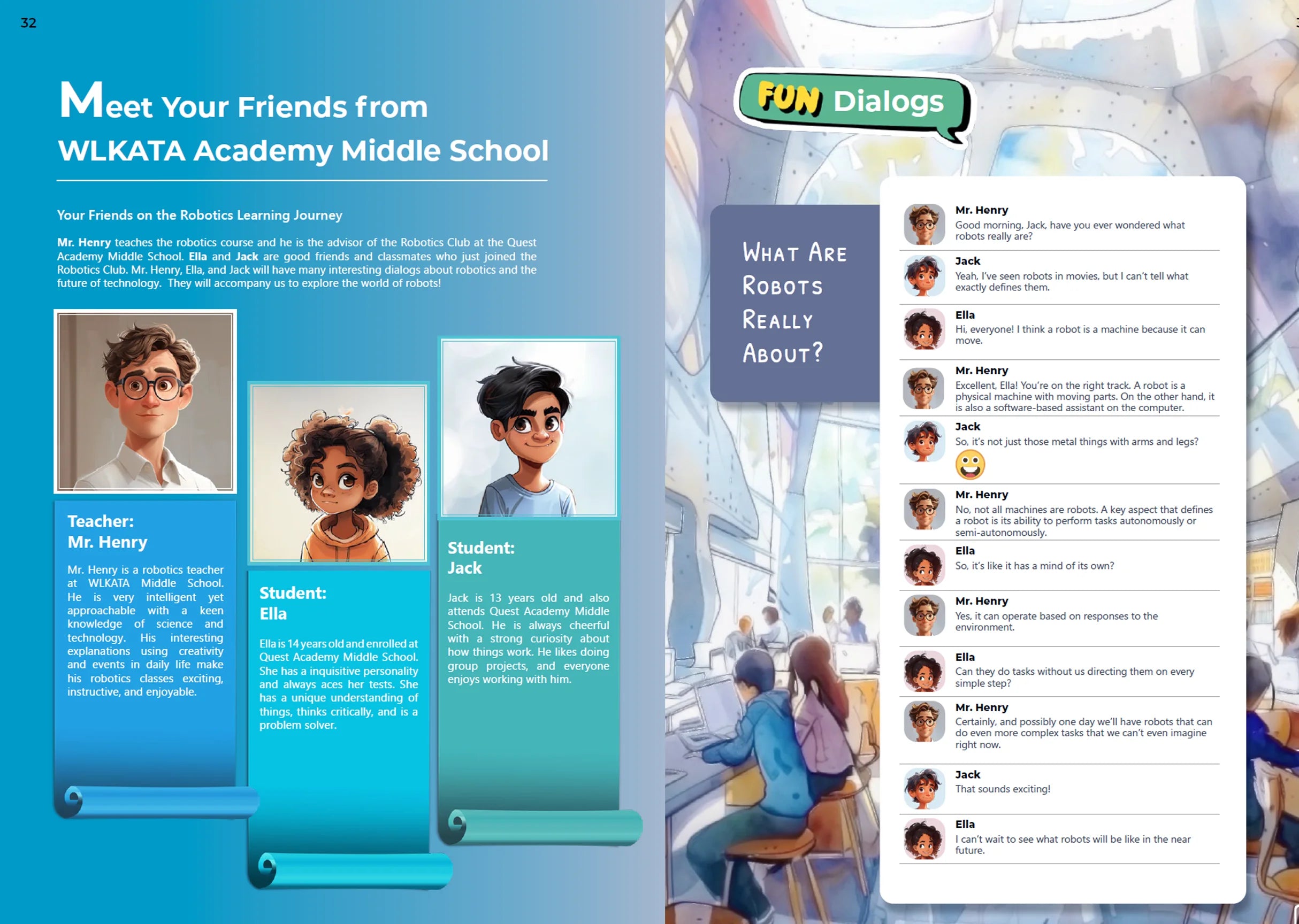
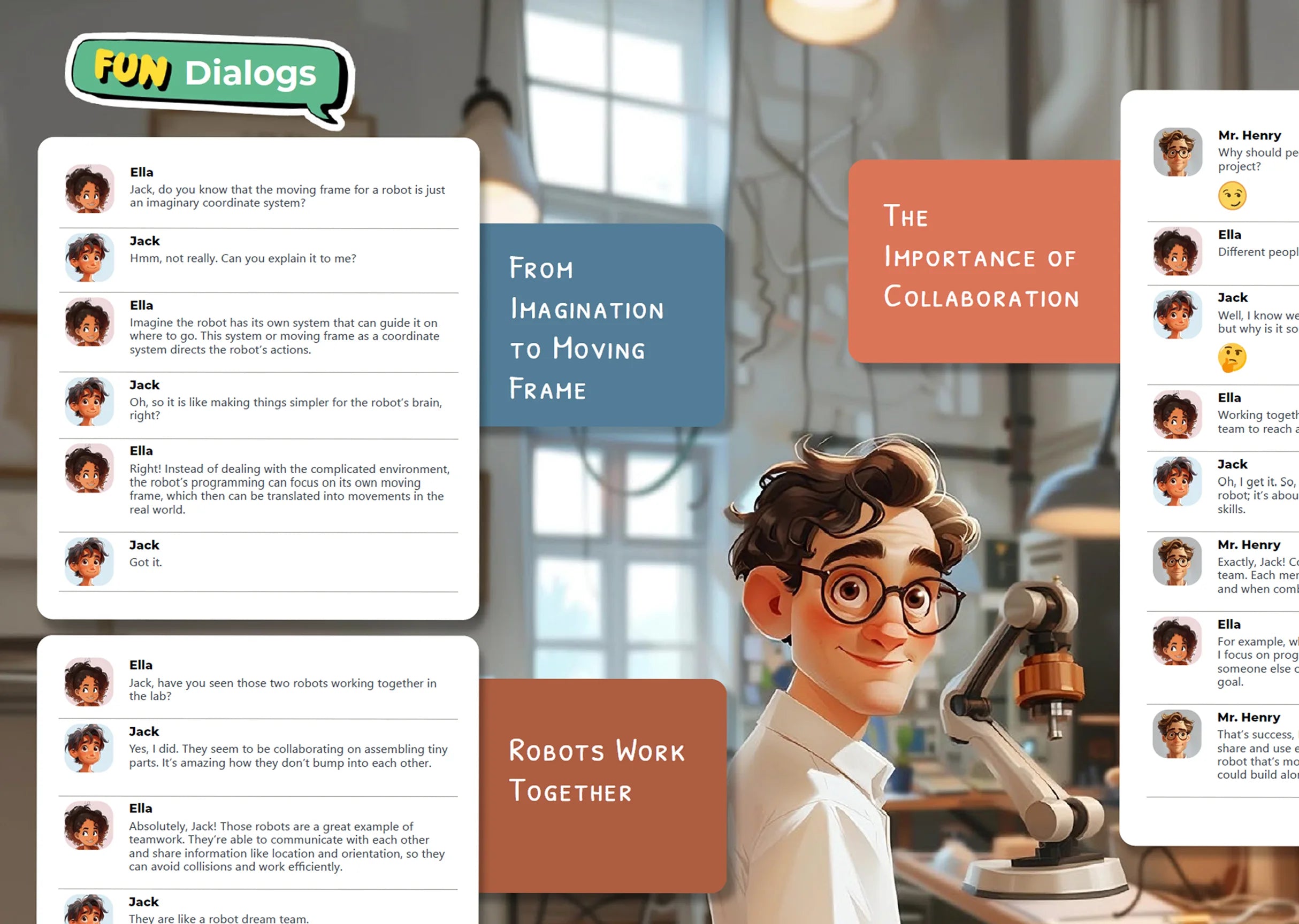
Chapter Dialogs That Encourage Discussion
Chapter Assessment — Check Understanding
Assessment is built into the learning sequence.
Chapter assessments ask students to recall ideas, interpret concepts, and connect what they learned to robotics and engineering thinking. Selected pages also link to interactive digital activities through QR codes.
End-of-chapter assessment
Concept and vocabulary review
Assessment key in the appendix
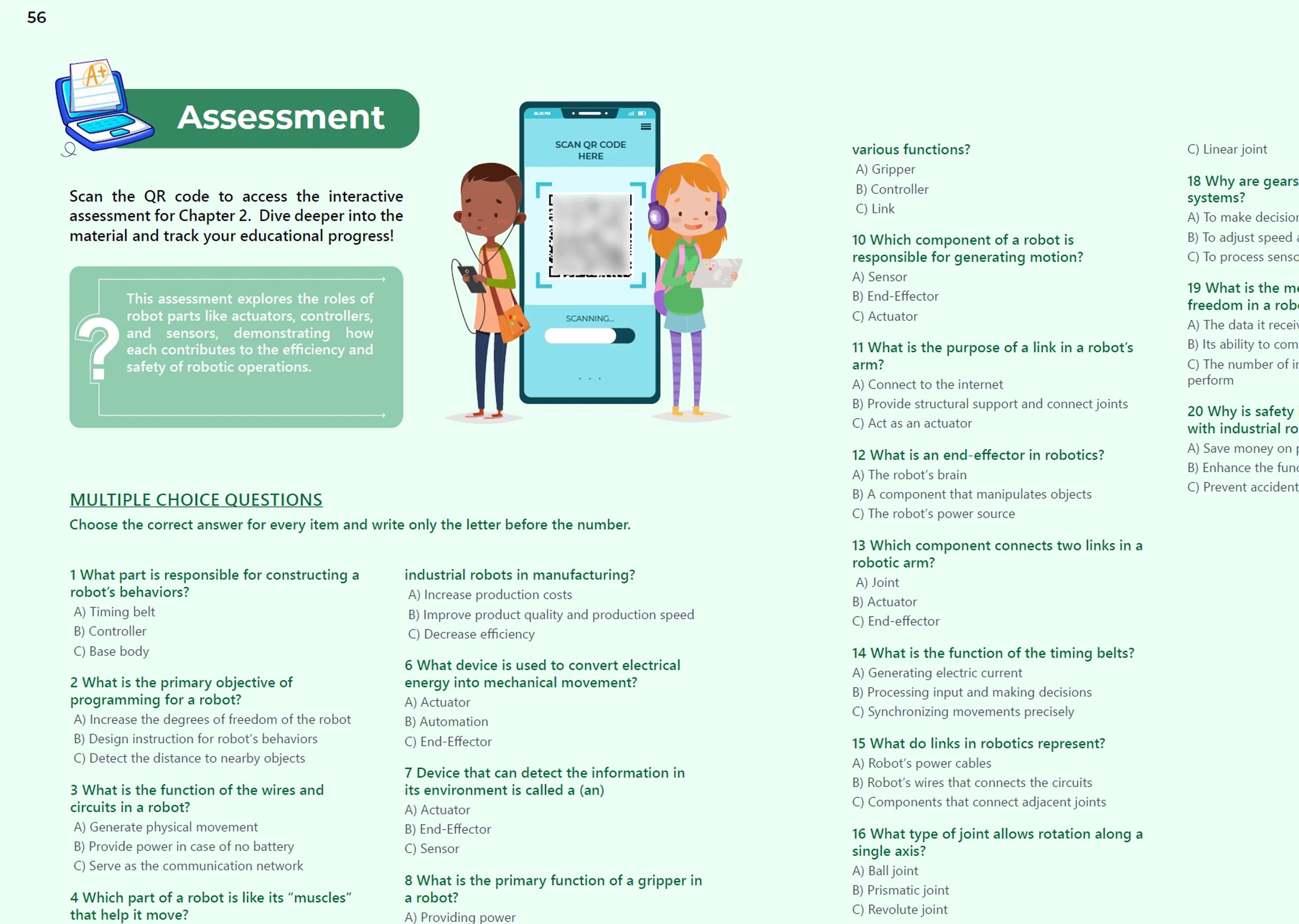
Chapter Assessment That Checks Understanding
Chapter Making & Doing — Apply What You Learn
"Making and Doing" moves learning off the page.
Students are asked to design, draw, investigate, program, build, reflect, or solve a problem. These sections help turn robotics from something students read about into something they can work with.
Design and engineering challenges
Creative problem solving
Student reflection and documentation
Hands-on or project-based extension
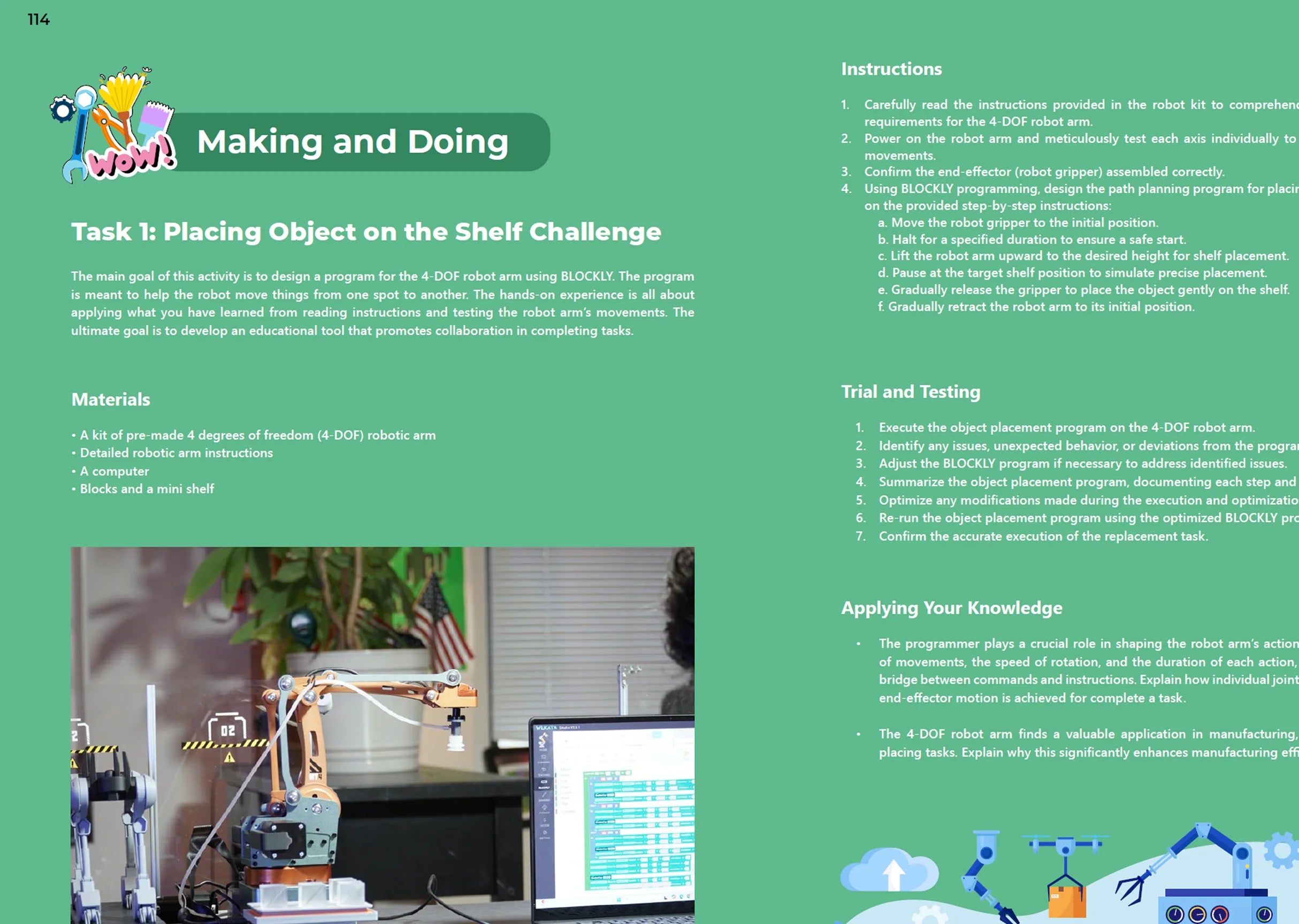
Chapter Making and Doing for Hands-On Application

HOW STUDENTS LEARN in Each chapter
Read → See → Discuss → Assess → Make
The book uses more than one route to understanding. A recurring learning rhythm helps students encounter the same idea in different ways.
Read
Structured explanations introduce the concept and vocabulary.
See
Illustrations, diagrams, real robots and everyday examples make abstract ideas visible.
Discuss
Student characters revisit ideas through friendly conversations.
Assess
Chapter questions check understanding and reinforce key ideas.
Make
Making & Doing pages ask students to design, investigate, create and reflect.
CHAPTER-BY-CHAPTER
What is inside the book?
Open a chapter to see its role in the learning progression and the major concepts students encounter.
Ten core chapters guide students from the concepts of robotics fundamentals to AI, followed by Appendix A: Glossary and Appendix B: Assessment Keys.
An introduction to robotics fundamentals — the history and purpose of robots, the main robot types, and why robotics is a multidisciplinary field connecting systems thinking, ethics and safety.
History and purpose of robotics · main features of robots · robot types · robotics as a multidisciplinary field · systems thinking, communication, creativity, collaboration, ethics and safety
Includes chapter review, dialogs, assessment, and Making & Doing activities as applicable.
A look at how robots are built, from structures and joints to the actuators, sensors and controllers that let them move and respond.
Robot structures · end-effectors · joints and links · Degrees of Freedom (DOF) · actuators · sensors · controllers · transmissions · robot control systems
Includes chapter review, dialogs, assessment, and Making & Doing activities as applicable.
How robots describe where they are and which way they face, using coordinate systems and point-to-point movement.
2D and 3D Cartesian coordinate systems · position · orientation · point-to-point movement · joints · spatial reasoning
Includes chapter review, dialogs, assessment, and Making & Doing activities as applicable.
Understanding reference frames and how they attach to a robot arm to describe position and orientation.
Robot frames · frame types · attaching frames to a robot arm · robot orientation · fixed and moving frames
Includes chapter review, dialogs, assessment, and Making & Doing activities as applicable.
How robots plan and follow paths, from point-to-point movement to real-world motion planning.
Paths · point-to-point movement · path planning · real-world constraints · industrial robot paths · Blockly path-planning concepts
Includes chapter review, dialogs, assessment, and Making & Doing activities as applicable.
Meet the families of robots and their end-effectors, and learn how to choose the right robot for each task.
End-effectors and applications · industrial manipulators · SCARA, Delta and Cartesian robots · special robots · choosing robots for different tasks
Includes chapter review, dialogs, assessment, and Making & Doing activities as applicable.
The physics behind robot motion — force, balance, torque and rotation applied to real robots.
Newton's three laws · force and motion · balance · torque and rotation · end-effector movement · applying physics to robots
Includes chapter review, dialogs, assessment, and Making & Doing activities as applicable.
How degrees of freedom, workspace and kinematics link joint motion to end-effector position.
Elementary robot arms · Degrees of Freedom · workspace · singularity · kinematics · links between joint motion and end-effector position
Includes chapter review, dialogs, assessment, and Making & Doing activities as applicable.
How robots sense their environment and act autonomously, from distance and force to vision.
Human senses and robot sensors · environment sensors · distance · acceleration · force · vision · autonomous vehicles · sensor selection for tasks
Includes chapter review, dialogs, assessment, and Making & Doing activities as applicable.
What AI is and how it works alongside robotics across industries, from finance and healthcare to manufacturing and energy.
What AI is · personal AI · finance and healthcare · transportation · logistics · agriculture · manufacturing · energy and environment · AI + robotics
Includes chapter review, dialogs, assessment, and Making & Doing activities as applicable.


ABOUT THE AUTHORS
Written from both robotics and education perspectives.
Ruiqing Jia, PhD
Robotics educator, researcher, designer, and Professor Emeritus of Mechanical Engineering. Co-founder of WLKATA Robotics
With decades of experience teaching, researching and designing robots, Dr. Jia brings deep technical authority to every page—grounded in a lifelong focus on robotics education and making complex systems approachable for new learners.
Marilyn LoPrest, MA
Educator, language arts curriculum writer, and experienced classroom teacher
Drawing on nearly 40 years as an educator at Lodi High School in Lodi, New Jersey, USA, Marilyn brings deep classroom experience to the book. She helps make technical ideas clear and engaging for school-age learners, shaping the dialogs, explanations, and pacing that keep students interested and learning.
Together, the authors combine robotics expertise with classroom experience—a balance reflected in the book's technical content, student dialogs, activities, and accessible explanations.
FOR EDUCATORS
Useful as a course spine—or as a visual robotics reference.
BOOK DETAILS
At a glance
Title
Illustrated Introduction to Robotics for Beginners
Authors
Ruiqing Jia, PhD · Marilyn LoPrest, MA
Audience
Ages 10–15, from upper elementary through middle school and early high school, and beginning robotics learners
Core content
10 chapters + glossary + assessment keys
Learning format
Illustrated lessons, real-world examples, dialogs, assessments, and Making & Doing activities
Book format
Available in both digital and physical copies
Suggested settings
Robotics, STEM, engineering, technology education, makerspaces, introductory CTE, clubs, homeschool, and independent study
A VOCABULARY THAT GROWS WITH THE LEARNER
Beginner-friendly without being watered down.
Robot structures · joints · links · actuators · controllers · sensors · end-effectors · Degrees of Freedom · Cartesian coordinates · position · orientation · robot frames · paths · Blockly · force · torque · workspace · singularity · kinematics · vision · autonomous vehicles · artificial intelligence · industrial robotics
A FIRST ROBOTICS BOOK WITH SOMEWHERE TO GO
Build the concepts students will need before the robots become more complex.
Students finish with more than a collection of robot facts. They leave with a framework for understanding how robots are built, how they move, how they sense, and how robotics connects to intelligent systems.